gradient-descent-deep-learning.md
Gradient Descent: The Hill-Climbing Algorithm Behind Deep Learning
Loss surfaces, learning rates, momentum, and Adam the optimization loop that makes neural networks actually learn.
- ML
- Math
- Deep Learning

Neural networks are function approximators. Gradient descent is how they find those functions by rolling downhill on a loss surface in million-dimensional space.
The loop
- Forward pass compute predictions
- Loss function measure error (
MSE, cross-entropy) - Backprop compute gradients via chain rule
- Update nudge weights opposite the gradient
for epoch in range(epochs):
    loss = compute_loss(model, batch)
    grads = autograd(loss, model.params)
    for param, grad in zip(model.params, grads):
        param -= learning_rate * grad
Repeat until loss plateaus or your cloud bill explodes.
Learning rate matters
Too high → oscillation or divergence. Too low → weeks of training.
| Strategy | Idea |
|---|---|
| Fixed LR | Simple, fragile |
| Step decay | Drop LR at milestones |
| Cosine annealing | Smooth decay curve |
| Warmup | Small LR early, stabilize |
Momentum
SGD with momentum accumulates velocity overshoots small local minima, accelerates through flat regions:
v = β * v + gradient
param -= lr * v
Think ball rolling downhill, gaining inertia.
Adam and friends
Adam adapts per-parameter learning rates using running averages of gradient and squared gradient. Default optimizer for most deep learning not always optimal, rarely catastrophic.
Local minima myth
In high dimensions, saddle points outnumber true local minima. Modern networks are overparameterized many global or near-global solutions exist. The hard part is finding them fast, not escaping traps.
Takeaway
Every LLM, every classifier, every diffusion model same core loop. Master gradient descent and backprop, and the rest of deep learning is architecture choices stacked on top.
Related
Continue reading
More notes on similar topics.

A frontend engineer's guide to the architecture behind GPT self-attention, positional encoding, and the encoder-decoder split.
- ML
- Transformers
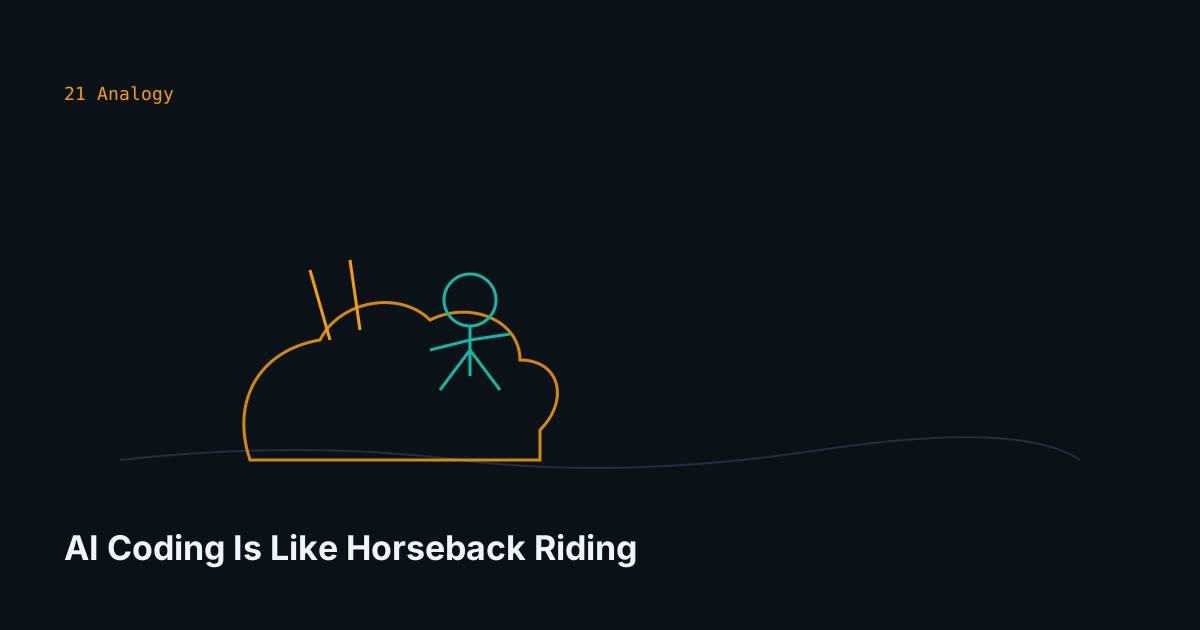
The horse is doing the running. You're still the one who has to stay balanced, read the terrain, and not fall off. That's the whole difference between vibe coding and actually directing the thing.
- AI Engineering
- Vibe Coding
The Day the Facility Guy Shipped a Feature to My App
July 29, 2026
I taught our building's maintenance guy how to vibe code for fun. Twenty minutes later he'd chatted his way into a working feature inside one of my real apps. Here's what actually happened, and why it didn't disprove anything I've written in this series.
- AI Engineering
- Vibe Coding