five-layers-ai-orchestrated-engineering.md
The Five Layers of AI-Orchestrated Engineering
Intent, Decomposition, Delegation, Verification, Synthesis the framework I use to turn 'AI writes code fast' into 'AI-assisted systems are correct.'
- AI Engineering
- Software Architecture
- Engineering Philosophy
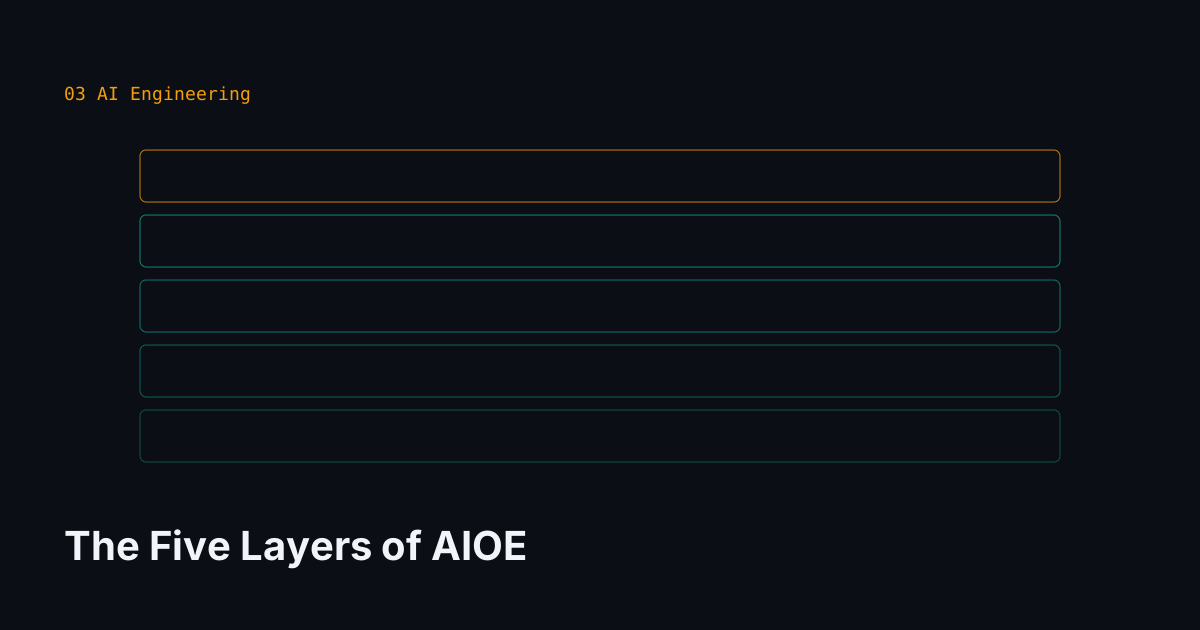
Part 3 of the AI-Orchestrated Engineering series. If the manifesto makes the case that AIOE is a distinct discipline, this post is the framework the five layers I actually run, in order, on real work.
Layer 1 Intent
Before any prompt gets written, the outcome gets specified in terms that don't depend on the AI at all: what correct looks like, what the constraints are, what "done" means. If you can't write this layer down, you're not ready to delegate anything you're about to gamble.
A useful test: could a competent engineer who's never seen an LLM read your Intent layer and know what "done" means? If not, it's not intent, it's a vibe.
Layer 2 Decomposition
Break the problem into units small enough that:
- a wrong answer in one unit is cheap to detect, and
- a wrong answer in one unit doesn't silently corrupt another.
This is the layer vibe coding skips entirely it hands the whole problem to the model in one prompt, which means a wrong turn on step one propagates, compounding, through everything downstream. Decomposition is what makes verification (Layer 4) actually tractable instead of a rubber stamp.
Good decomposition looks like the boundaries you'd draw for a human team: modules, interfaces, independent subsystems. The AI doesn't need protection from complexity you need protection from a defect that's had time to spread.
Layer 3 Delegation
Now the AI enters. Each decomposed unit goes to whichever combination of AI assistance and human effort fits it some units the model drafts entirely, some it pairs on, some stay fully human (security-critical logic, the parts where "mostly right" isn't good enough). Delegation is a decision, not a default.
This is also where parallelism lives: independent units can be worked simultaneously by multiple prompts, multiple sessions, multiple agents precisely because Layer 2 made them independent.
Layer 4 Verification
Every delegated unit is checked against Layer 1's definition of correct before it's trusted tests, a second independent read, a spec diff, adversarial review. This is not optional and it is not "run it once and see." The check has to be capable of failing, or it isn't a check.
The strongest version of this layer treats verification itself as adversarial: assume the output is wrong and look for the proof, rather than assuming it's right and looking for confirmation. Those produce very different review habits.
Layer 5 Synthesis
Verified units get integrated back into one coherent system and this is where architectural judgment does its final pass. Do the pieces actually fit together the way Layer 1 intended? Did decomposition introduce a seam that doesn't belong? Synthesis is the layer that catches "every part passed review, but the whole doesn't hang together" a failure mode invisible to Layer 4 because no single unit exhibits it.
Why five, and why in this order
Each layer exists to catch what the previous layer can't. Intent catches "we're solving the wrong problem." Decomposition catches "the problem is too big to verify." Delegation catches "we're using AI where it doesn't belong." Verification catches "the output looks right but isn't." Synthesis catches "every piece is right but the system isn't."
Vibe coding has, at most, layer 3 and a degenerate version of it, where delegation means "everything, always, to the model." Removing layers 1, 2, 4, and 5 is exactly what makes it fast and what makes it fail silently. The speed and the fragility come from the same missing structure.
Next: the practical patterns for running Layers 3 and 4 at scale Orchestration Patterns: Directing AI Like a Systems Architect.
Related
Continue reading
More notes on similar topics.
The horse is doing the running. You're still the one who has to stay balanced, read the terrain, and not fall off. That's the whole difference between vibe coding and actually directing the thing.
- AI Engineering
- Vibe Coding

The Day the Facility Guy Shipped a Feature to My App
July 29, 2026
I taught our building's maintenance guy how to vibe code for fun. Twenty minutes later he'd chatted his way into a working feature inside one of my real apps. Here's what actually happened, and why it didn't disprove anything I've written in this series.
- AI Engineering
- Vibe Coding
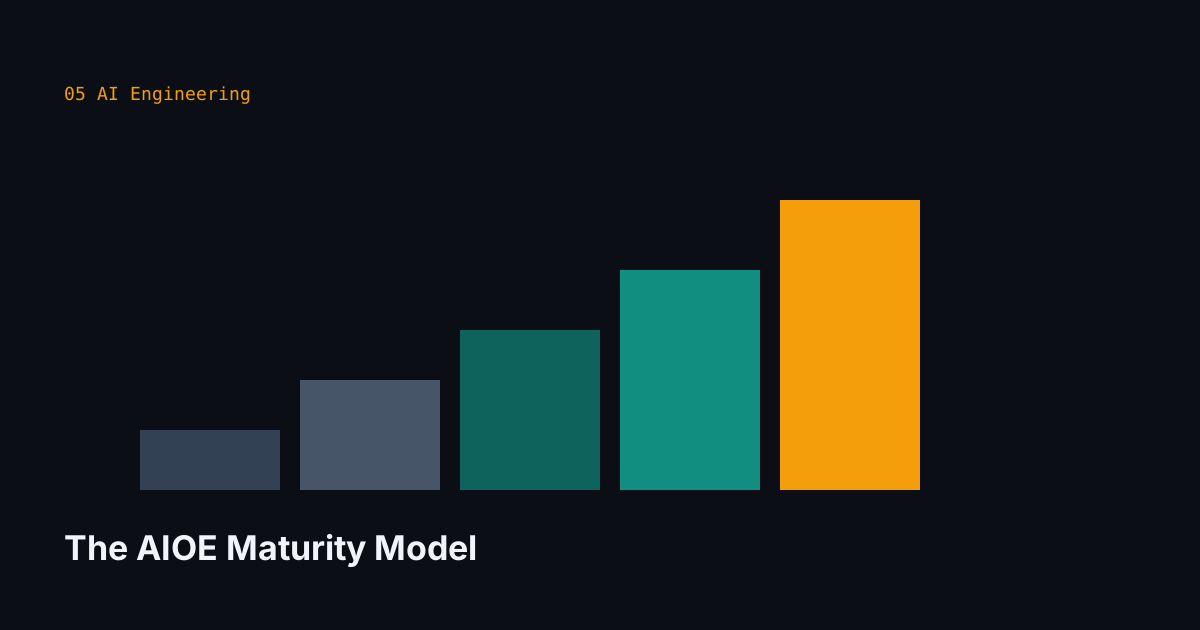
A five-level, self-scoring checklist to find out honestly whether your AI-assisted workflow is AI-Orchestrated Engineering or vibe coding with extra steps.
- AI Engineering
- Engineering Philosophy