orchestration-patterns-for-engineers.md
Orchestration Patterns: Directing AI Like a Systems Architect
Pipeline, fan-out/fan-in, adversarial verification, judge panels the distributed-systems patterns that make AI-Orchestrated Engineering practical instead of aspirational.
- AI Engineering
- Software Architecture
- Distributed Systems
Part 4 of the AI-Orchestrated Engineering series. The five-layer framework says what to do at each stage. This post is how the concrete patterns I reach for, borrowed almost directly from distributed systems, because directing several units of AI-assisted work is structurally the same problem as directing several worker nodes.
Pipeline
Independent work items move through the same sequence of stages, but without a barrier between stages item A can hit stage 3 while item B is still on stage 1.
item -> [draft] -> [test] -> [review] -> [integrate]The win is wall-clock time: total duration tracks the slowest single item's full chain, not the sum of every item's slowest stage. Reach for this whenever items don't need each other's results mid-flight which, if Decomposition (Layer 2) did its job, is most of the time.
Fan-out / fan-in
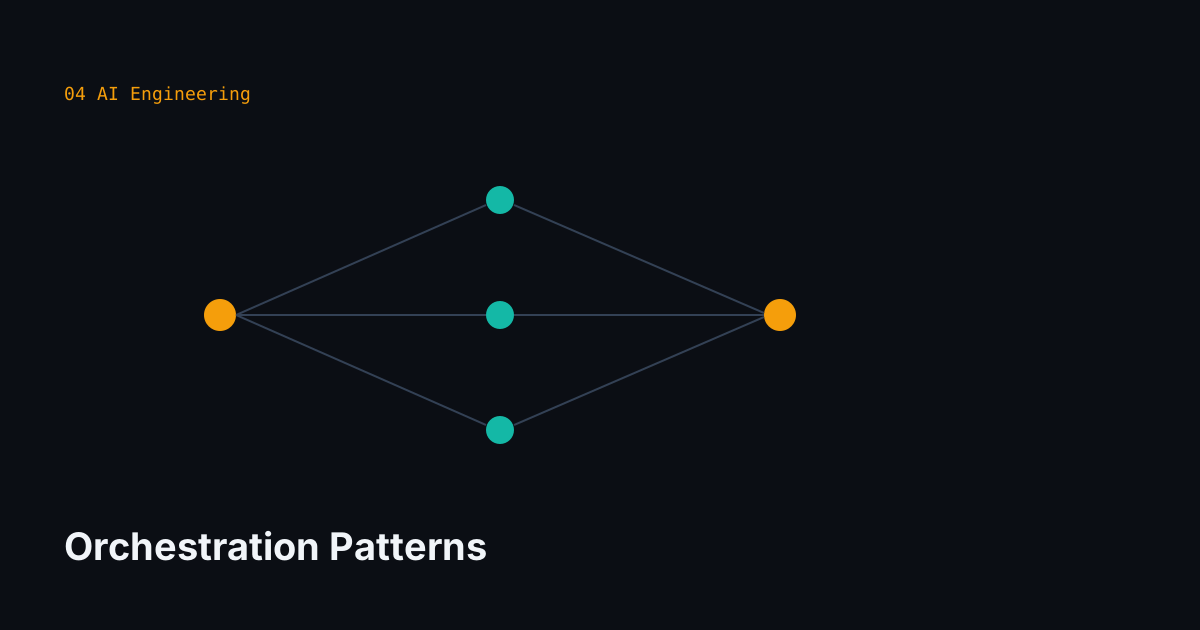
One problem splits into N independent workers running concurrently, then results converge for a single synthesis step.
            +--> worker A --+
problem --> +--> worker B --+--> synthesis
            +--> worker C --+
Use fan-out/fan-in specifically when Synthesis (Layer 5) genuinely needs all results together deduplicating overlapping findings, picking a winner among competing drafts, checking that nothing was covered twice or missed entirely. That's a real barrier, not a convenience one. If nothing downstream needs the full set at once, you don't need this pattern pipeline is faster.
Adversarial verification
Instead of one pass asking "is this right?", spawn independent reviewers instructed to refute the work find the reason it's wrong, not confirm that it looks fine. Kill the result if a majority of independent attempts find a real problem.
This matters because confirmation-seeking review and refutation-seeking review catch different things. A reviewer primed to check "does this look plausible" reliably misses what a reviewer primed to ask "how would this be wrong" catches. Plausible-but-wrong is exactly the failure mode vibe coding is defenseless against adversarial verification is the direct countermeasure.
Judge panels
For a problem with more than one reasonable solution shape, generate several independent attempts from genuinely different angles (correctness-first, performance-first, simplicity-first), score them independently, and synthesize taking the winning approach's structure while grafting in specific strong ideas from the runners-up.
This beats iterating on one attempt when the approach itself is uncertain, not just the implementation details. One attempt, iterated, converges on a local optimum of whatever angle you started with. A panel actually explores the space.
Loop-until-dry
For open-ended discovery bugs, edge cases, missing coverage a fixed count ("check five things") misses whatever's in the tail. Instead, keep generating find-passes until N consecutive passes turn up nothing new, then stop. The stopping condition is saturation, not a quota.
The common thread
None of these patterns are AI-specific. They're the same patterns you'd use to direct a team of competent engineers on a deadline: split independent work, converge where you genuinely need everyone's input, get someone whose job is to find the flaw instead of confirm the plan, and keep exploring until you've actually run dry. AI-Orchestrated Engineering isn't a new kind of engineering management it's the same discipline, pointed at a much faster instrument.
Last in the series: a way to check where you actually stand A Maturity Model for AI-Assisted Engineering.
Related
Continue reading
More notes on similar topics.
The Five Layers of AI-Orchestrated Engineering
July 18, 2026
Intent, Decomposition, Delegation, Verification, Synthesis the framework I use to turn 'AI writes code fast' into 'AI-assisted systems are correct.'
- AI Engineering
- Software Architecture
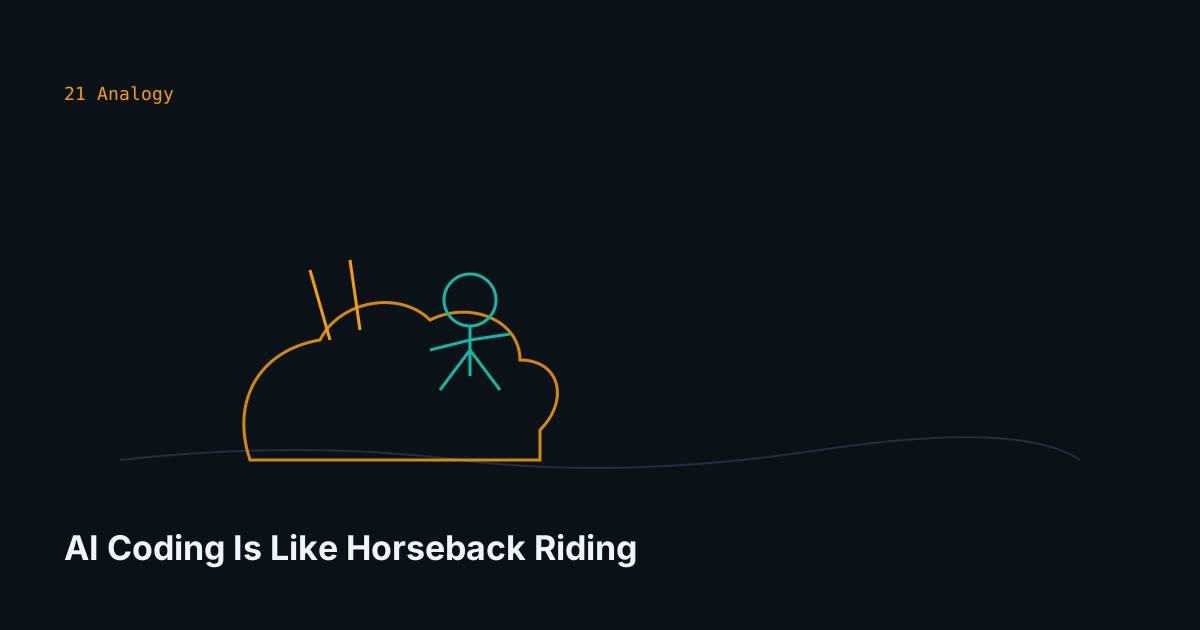
The horse is doing the running. You're still the one who has to stay balanced, read the terrain, and not fall off. That's the whole difference between vibe coding and actually directing the thing.
- AI Engineering
- Vibe Coding

The Day the Facility Guy Shipped a Feature to My App
July 29, 2026
I taught our building's maintenance guy how to vibe code for fun. Twenty minutes later he'd chatted his way into a working feature inside one of my real apps. Here's what actually happened, and why it didn't disprove anything I've written in this series.
- AI Engineering
- Vibe Coding