ai-orchestrated-engineering-maturity-model.md
Are You Orchestrating or Vibing? A Maturity Model for AI-Assisted Engineering
A five-level, self-scoring checklist to find out honestly whether your AI-assisted workflow is AI-Orchestrated Engineering or vibe coding with extra steps.
- AI Engineering
- Engineering Philosophy
- Software Quality
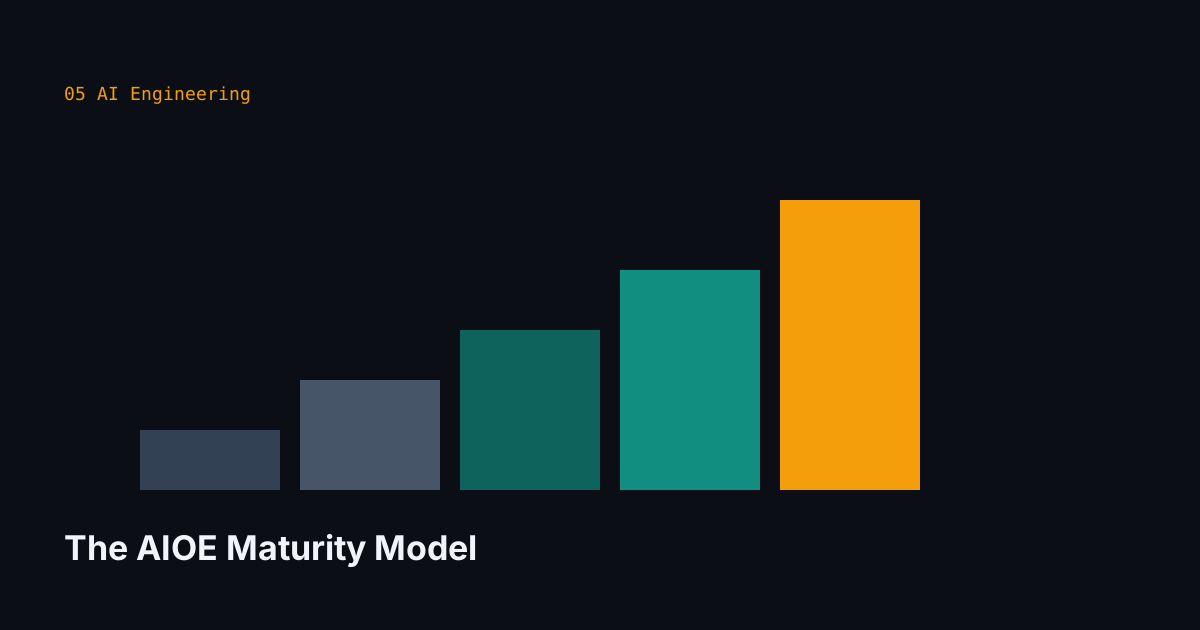
Closing part of the AI-Orchestrated Engineering series. The manifesto named the discipline, the five layers framed the process, orchestration patterns gave the mechanics. This is the mirror: a maturity model to check where a given workflow yours, your team's actually sits, level by level.
Score each level honestly. You're not done with a level until every item is true most of the time, not on your best day.
Level 0 Pure vibe coding
- Prompt → paste → run → if it crashes, paste the error back
- No step exists whose job is to say "no"
- "It ran" is the definition of done
- You couldn't describe the system's architecture without rereading the code
If this is you, you're not orchestrating anything you're gambling with a very fast dealer. Nothing wrong with using it to throw away a prototype. Everything wrong with shipping it.
Level 1 Supervised generation
- You read every diff before accepting it
- You know what you asked for and can tell if the output matches
- You still have no explicit spec correctness is "looks right to me"
- Verification is a single human glance, not a check that can fail
This is most people's honest starting point. It's real progress over Level 0 a human is in the loop but "looks right to me" doesn't scale past the size of code one person can hold in their head, and it catches nothing subtle.
Level 2 Specified delegation
- Before delegating, you write down what "correct" means for this unit (Layer 1: Intent)
- The problem is broken into units small enough to verify independently (Layer 2: Decomposition)
- You deliberately choose what to delegate vs. keep human-only (Layer 3: Delegation)
- Every unit has some check beyond "I looked at it" a test, at minimum
This is the threshold of AI-Orchestrated Engineering. It's not fully mature yet, but the structural difference from vibe coding already exists: there's a step whose job is to catch a wrong answer.
Level 3 Adversarial verification
- Verification actively tries to refute the output, not just confirm it looks fine
- High-stakes units get more than one independent check
- You can point to a specific defect your process caught before it shipped, in the last month
- Synthesis is a real step you check the integrated whole, not just the sum of verified parts (Layer 5)
Most teams that think they're "doing AI engineering well" plateau here, and it's a genuinely good place to be. The gap to Level 4 is about process, not effort.
Level 4 Orchestrated at scale
- Independent units run in parallel by design (fan-out/fan-in or pipeline), not by accident
- Discovery work (bugs, edge cases, missing coverage) runs until it demonstrably stops finding new things, not until you get bored
- The process is repeatable by someone other than you it's documented as a process, not tacit knowledge in your head
- You can scale scope 10x by running the same process more, not by working harder per prompt
Level 4 is where "AI-Orchestrated Engineering" stops being a philosophy and becomes an operating model the same rigor at any scope, because the rigor lives in the process instead of in how carefully you happened to read one diff.
Using this honestly
The point of a maturity model isn't the score it's the next unchecked box. If you're at Level 1, the highest-leverage move is writing down what "correct" means before you prompt (Level 2's first item), not jumping straight to parallel fan-out patterns you don't have the verification discipline to support yet.
Vibe coding is what happens when none of these boxes are checked and nobody notices. AI-Orchestrated Engineering is what happens when you check them on purpose, in order, every time the scope gets big enough to tempt you not to.
Related
Continue reading
More notes on similar topics.
Vibe coding feels fast because it defers all its cost to later. A field guide to the five failure modes I see over and over and why they're structural, not incidental.
- AI Engineering
- Engineering Philosophy
The horse is doing the running. You're still the one who has to stay balanced, read the terrain, and not fall off. That's the whole difference between vibe coding and actually directing the thing.
- AI Engineering
- Vibe Coding
The Day the Facility Guy Shipped a Feature to My App
July 29, 2026
I taught our building's maintenance guy how to vibe code for fun. Twenty minutes later he'd chatted his way into a working feature inside one of my real apps. Here's what actually happened, and why it didn't disprove anything I've written in this series.
- AI Engineering
- Vibe Coding