ai-orchestrated-engineering-manifesto.md
AI-Orchestrated Engineering: A New Discipline Beyond Vibe Coding
Vibe coding treats AI as an oracle you gamble on. AI-Orchestrated Engineering treats it as an instrument you conduct. Here's the discipline I've been building and why the distinction matters.
- AI Engineering
- Engineering Philosophy
- AI
I need to name something, because I'm tired of being lumped in with it.
Vibe coding is: paste a prompt, accept whatever comes back, run it, patch the crash, paste another prompt. No architecture in your head, no verification loop, no idea why the code works just a feeling that it probably does, until it doesn't. It's gambling with syntax. It ships demos and quietly detonates in production.
What I actually do what I think a growing number of serious engineers are converging on, whether they've named it or not is different in kind, not just degree. I'm calling it AI-Orchestrated Engineering (AIOE).
The distinction
| Vibe Coding | AI-Orchestrated Engineering | |
|---|---|---|
| Unit of work | A prompt | A decomposed problem |
| Role of the human | Prompt-and-pray | Conductor, architect, verifier |
| Role of the AI | Oracle | Instrument one of several |
| Correctness check | "It ran" | Explicit verification against a spec |
| Failure mode | Silent, compounding | Caught at the boundary it was introduced |
| What scales | Nothing every prompt is a fresh gamble | The process same rigor at 10x scope |
Vibe coding optimizes for the feeling of speed. AI-Orchestrated Engineering optimizes for the actual output: correct, maintainable systems, produced faster than solo human engineering without surrendering the judgment that makes engineering engineering.
What "orchestration" actually means here
I don't mean "use more than one AI model." I mean applying the discipline that already exists in distributed systems and engineering management decomposition, delegation, parallel execution, verification, synthesis and pointing it at AI capability instead of (or alongside) human teams.
A conductor doesn't play every instrument. They hold the score, know what each section is capable of, cue entrances, and catch the wrong note before the audience does. That's the posture. The AI plays fast. You hold the score.
Concretely, that means:
- Problem decomposition before delegation. You don't hand an LLM "build the feature." You break it into units small enough that a wrong answer is cheap to catch and cheap to redo.
- Explicit verification, not vibes. Every AI-produced unit gets checked against something a test, a spec, a second independent pass before it's trusted. "It compiled" is not verification.
- Parallelism where the problem allows it. Independent subproblems get worked independently by the AI, by you, by both instead of serialized into one long prompt chain.
- The human owns the architecture. Data flow, invariants, failure modes, security boundaries these are decided by an engineer who understands the system, not inferred from whatever the model produced last.
- Iteration is structural, not accidental. You don't fix bugs by re-prompting and hoping. You fix them by finding which stage of the process let the defect through, and correcting the process.
Why this needs a name
Fields move faster once they can name their own concepts. "Vibe coding" already has a name coined, mocked, and understood widely enough that saying it communicates something precise: reckless, unverified, prompt-driven development. That name did real work; it gave people a shared target to critique.
But the absence of a name for the serious alternative has a cost. Right now, "I use AI to write code" describes both a person who ships unreviewed hallucinations to production and a person who runs a rigorous, verified, multi-stage engineering process with AI doing the typing. Those are not the same activity, and conflating them under "vibe coding" or under no label at all makes it harder to teach, hire for, or hold to a standard.
So: AI-Orchestrated Engineering. I'm coining it here, on this post, on this date, because I think it's the actual shape of where competent software engineering is heading not "AI replaces engineers" and not "AI is a toy for gambling with," but AI as an instrument under the direction of an engineer who still does the thinking.
This is a series
This post is the manifesto. Over the next four posts I'm going to make the concept load-bearing instead of just aspirational:
- The Vibe Coding Trap the concrete failure modes, so "vibe coding is bad" stops being a vibe itself.
- The Five Layers of AI-Orchestrated Engineering the actual framework: Intent, Decomposition, Delegation, Verification, Synthesis.
- Orchestration Patterns the practical patterns (pipelines, fan-out/fan-in, adversarial verification) borrowed from distributed systems and applied to directing AI.
- A Maturity Model for AI-Assisted Engineering a checklist to find out, honestly, whether you're orchestrating or just vibing with extra steps.
If "vibe coding" named the problem, this series is my attempt to name and build out the discipline that replaces it.
Related
Continue reading
More notes on similar topics.
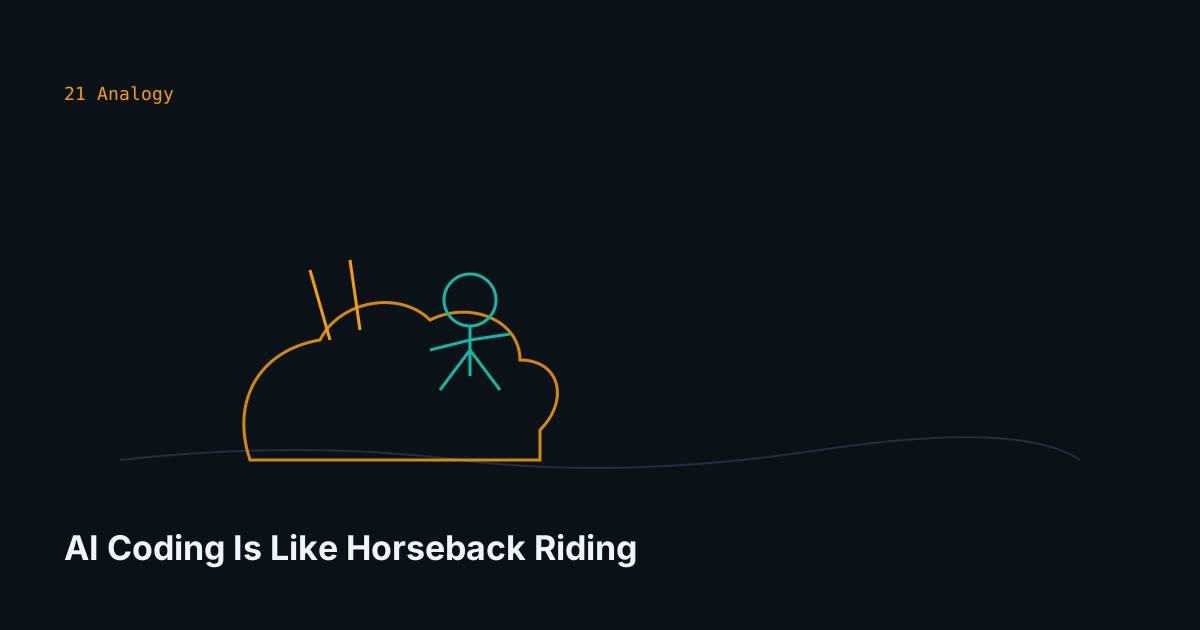
The horse is doing the running. You're still the one who has to stay balanced, read the terrain, and not fall off. That's the whole difference between vibe coding and actually directing the thing.
- AI Engineering
- Vibe Coding

The Day the Facility Guy Shipped a Feature to My App
July 29, 2026
I taught our building's maintenance guy how to vibe code for fun. Twenty minutes later he'd chatted his way into a working feature inside one of my real apps. Here's what actually happened, and why it didn't disprove anything I've written in this series.
- AI Engineering
- Vibe Coding
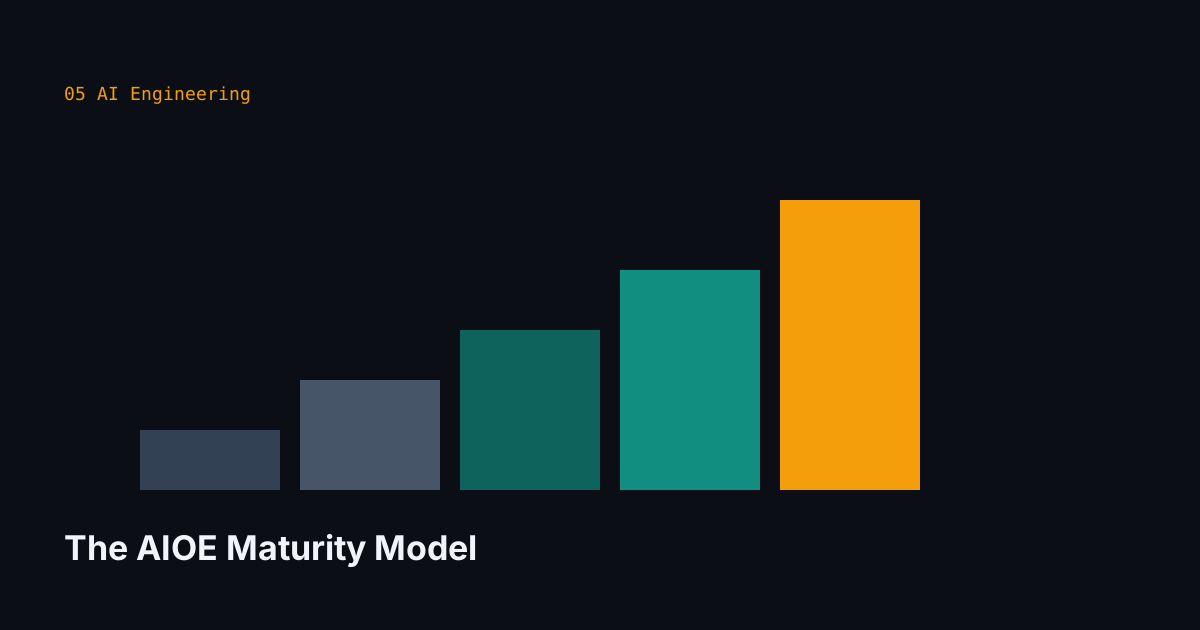
A five-level, self-scoring checklist to find out honestly whether your AI-assisted workflow is AI-Orchestrated Engineering or vibe coding with extra steps.
- AI Engineering
- Engineering Philosophy